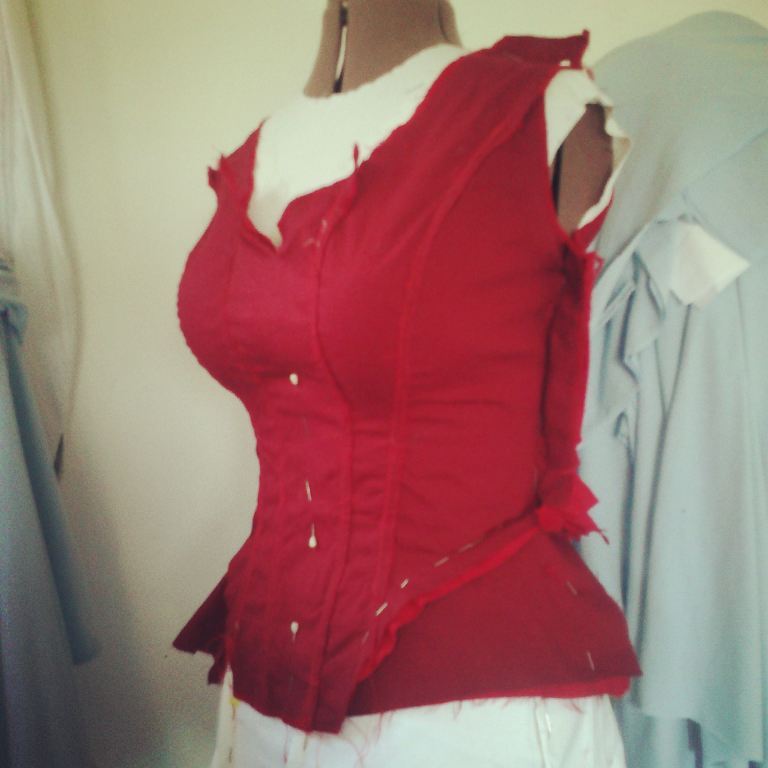
Okay so while looking for photos for insurance I found my first photos of my new Mina bodice and had quite a revelation.
So I find it very painful to do fitting for historic gear. It’s physically painful.
I have helped that a bit with The Mina because I shaped all panels before putting eyelets in the back so I can lace it closed even during fitting.
But I’m having trouble with boning because well it’s also painful to cut. and to handle in general.
And I realised where most of my fitting trouble is which is the bust.
I need to cord the whole thing!
I want a mid-late 1870s shape and to get that cording is often used in the hip and bust gores.
Of course!
SO this is great.
My Marie antoinette stays need a lot of topstitching before I can bone that too and I may even use a bit of cording in that to soften some of the harshness of the metal stays.
I didn’t account for cording in my pattern but I have a good seam allowance at the sides.
The cording is going to help retain the shape I carefully created in fabric as it collapses off the form.
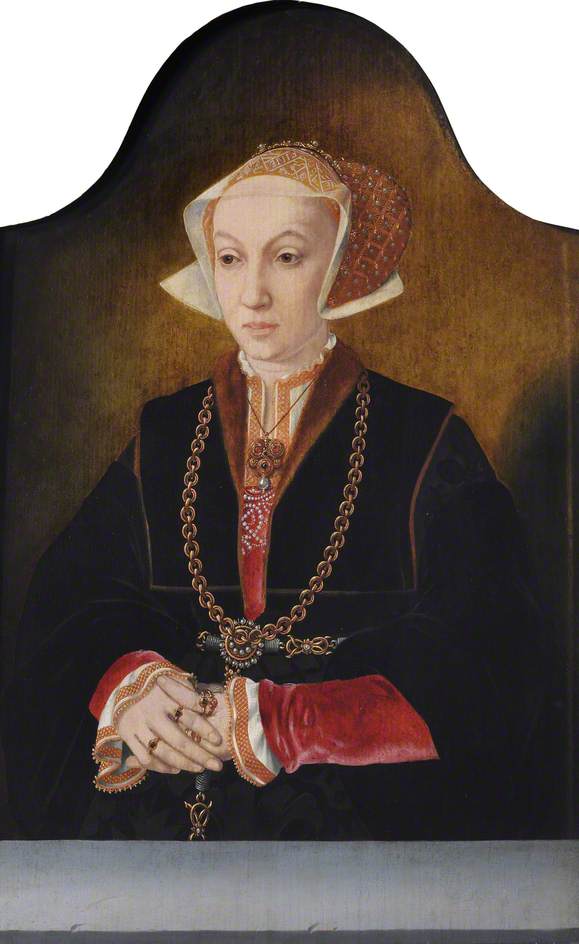
I think in Anglo-centric writings and art history there has been a lot of context missing when interpreting the clothing depicted in the portraits of Anne of Cleves.
I have also been looking through modelbuchs at embroidery and found some patterns that seem to be used in art (if not in entirely there are deer/hart that look to be worked in a similar fashion.
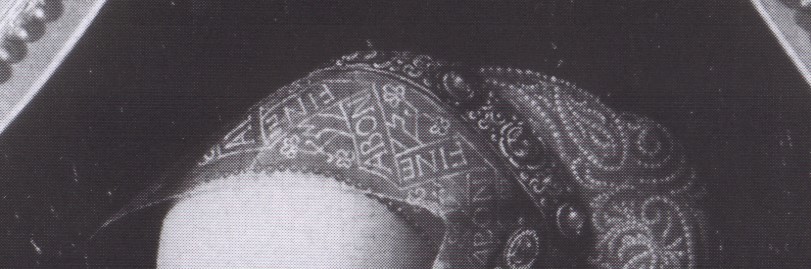
I was not able to find any pattern for the scrolling embroidery/weave of the fabric of Anna’s haube which reads “abon fine.”
This phrase has been interpreted to be her personal motto. However this same pattern is found on the clothing of other women across the Germanic states.
Burkmair was active in Augsburg and this portrait is of an Augsburg citizen.
Here the phrase is “a bon fino” In all cases “a bon” is contracted to read as “ABON.”
And on one of my favourite gowns of one of my favourite women in fashion history:
http://www.hdbg.de/portraitgalerie/gemaelde-18-zoom.php Bildnisdiptychon -Rechte Tafel: Bildnis der Maria Jacobaea von Baden, Herzogin von Bayern Maler: Hans Wertinger Datiert: 1526 Bild: Öl auf Holz, 69 x 45 – Inv.-Nr. 18
Of special interest is that his appears to be worked in pearls while the previous seem to be woven or embroidered in dark silk on gold, or may even be gold work.
Anne of Cleves has this motto in a similar pattern (capitalised on a geometric scroll effect outline, worked in alternating diagonal directions on a wide band.
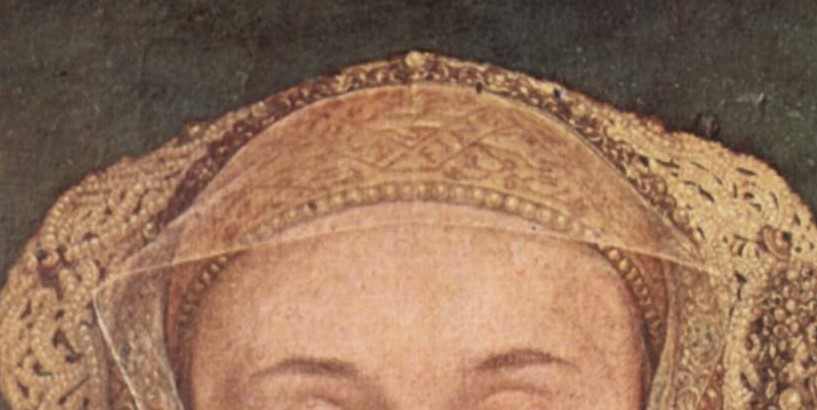
Holbein’s portrait quite clearly show the design worked in red on gold. This may be woven as are most bands on hauben from this region. Most commonly they are purely geometric designs but of a similar scale.
Bruyn in particular captures the gold threads of woven patterns of women of Cologne.
St John’s copy of the Bruyn portrait (note the portrait I believe to be the original has a flat pearled baret masking the view of her haube. I believe the copies to not include the hat are copies as they do not perfectly represent the Stickelsche as it appears in work direct from Cologne. )
The design is worked upside down in comparison to all others (and this is repeated in other copies.) It is also worked in a pale colour, in the small digital copies it appears white or off white.
So this leads me to the most recently discovered potential portrait of Anna.
Having spent many years looking at Anne she doesn’t look anything like her. I have several portraits of the same women at different ages painted by the Bruyn workshop and there isn’t any resemblance to the Rosenbach portrait by Bruyn nor the Holbein portraits.
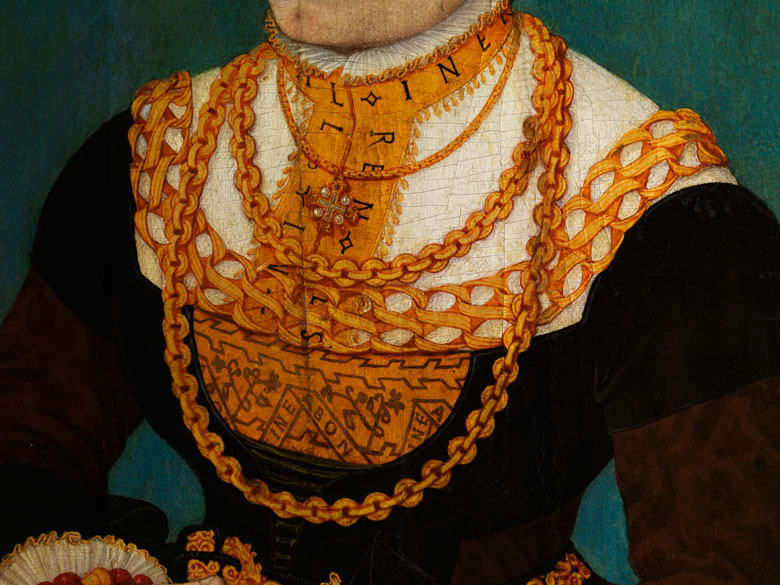
After a decade or more of looking at North Rhine paintings what sticks out to me is that this is absolutely not the clothing of Nobility of Cleves, Julich, and Berg. This is absolutely perfect for middle class clothing of Cologne. Very wealthy but very clearly of someone affected by sumputary laws.
Red velvet sleeves and brusttuchs are found repeatedly in inventories/documents of burgersfrau of Cologne.
The pendant is absolutely of a common shape, the girdle of a common type, the single wide chain necklance. Even the black on black fabric of her goller (kleyr) and gown.
The partlet under her gown is likewise of a type that puts her firmly in the city of Cologne.
It is also quite late in style. I would put this at 1550s. But this stage the Hat starts to look like a wing nut with a flat top and not just width at the upper side but lower side and is quite flat in regards to depth. And it very quickly changes shape again so that the sides sit much higher. After that it gets pinched back to the point it’s very hard to even see them behind the various linen pieces.
Commemorative paintings are not unusual, what is unusual is to lower the apparent status of the subject. Gold brocade trim on the gown at the very least would mark the subject as of nobility.
The painting looks from the surface to be from Bruyn’s workshop. The curved top of the canvas (though not the only shape), the shaded plain background, the flat table top in front of the subject. These are also seen in the other copies of the Rosenbach Bruyn.
Without access to information about the painting itself this asks many more questions than it answers.
In all the copies the words are upside down and in pale paint on warm gold. Could this indicate they are painted by someone not familiar with the physical properties of these hauben? Could that indicate they are all copies from outside of her homeland?
If so how can the details of this portrait match so well to the garments of burgersfrau of Cologne?
If this is by Bruyn (possibly the younger) does this mean the princesses could have worn clothing not indicative of their wealth? Or is this a deliberate statement?
Or could it be simply a portrait of an unrelated woman from Cologne?
There is very little in the way of imagery of real people from Cleves, Julich, and Berg from this time to be found online or printed in books. I have been very lucky to have a copy of the inventory of Jocabe of Juelich-Kleve-Berg but it is very definitely from a time where the Spanish influence has nearly overwritten the local clothing style. I have also been lucky enough to find/be lead to collections of inventories of women of Cologne.
A future blog post will explore the artwork of the Duchy, specifically those of the Duchess Maria and her Daughters (Sibylla, Amalia, and Anna.)
Currently in bed listening to The Good Place which is my go to when I feel down or tired. It is so good.
Today I have managed to finish the artwork for all the skirts and have imported half the bodices.
I forgot how very quickly I can learn something new. But I am also itching to be finished with this so I can share the darn thing!
I also am a bit behind due to spending a morning cutting waxed paper to repair one of my precious research books. One of the best biographies of Anne of Cleves. Mr Carlo is litter phobic and well….. My book is was in the crossfire.
I’m sad because I kept it in such good condition. But now I have been able to remove the illustrated pages and scan them. I’ve seen my previous scan copied and shared so I’ll try and put out the most information.
So I also got the skirt illustrations in the book file. It’s too slow loading, so I may make the whole book into more discrete parts so as to not overload my computer.
After years and years of searching I agree, yes, stickelchen does refer to headgear. It’s been harder to confirm than might be thought, however dictionaries of the region during the time frame that the term was used are rare. But one has been found. A copy and a transcription.
*faints*
“sticksel” seems to be the original term. But it still may refer to the band at the front, not the bulk of it.
Why is is so difficult?
A “stuck” is a piece and “stick” can refer to a pointed stick, literally, or embroidery.
And “chen” is a diminuitive. Also “gin.”
So little embroidery just doesn’t seem correct for a rather large hat.
And at the time “perlen” was most frequently used to describe pearled pieces.
Many of the headpieces were pearled, or made from gold fabric, or covered in netted work. Rarely do they seem to be embroidered in a general sense.
The front piece more regularly is decorated in pearls or jewels.
Clothing is also tough. There are lots of garments, but very little in the way of definition. Rock might be a gown or it may be a skirt alone. And the lovely huge inventory I have is full of spanish styles!
I’ll just have to take time to read the full texts not just skim! 😉
I really should just publish what I have and build on it later. It’s hard though as I really want to do everything at once. But I don’t even have good photos of my early work! I’ve passed so much of it on but really have no decent photos of any of it. So I really feel like my own history is lacking, let alone how that feeds back to me from the public. But it does sort of mean I’d like to remake a few things in new fabric…
That said, just looking up frazzled frau on google brings my old tripod site up! I really need to see if I can open that up again 🙂 Oh man, looking at all the lovely comments about my old site really makes me want to get her all properly revved up again. If you like something tell the person 🙂
It’s tough because there has been a massive influx of images in the last few years. But I do have pin boards, and my tumblr is still there, but a bit forgotten, sorry!
I have some in progress boards to come up, but it’s rare that any pin I add is uncredited. I try and find the most current location. Usually that means the best quality but not always. But it means people finding and bookmarking pins should be able to just click and go at their convenience. Even so, some museums change their content enough that I will have to go back and check some. The Metropolitan Museum of Art has recently upgraded their databases to an amazing degree, but it means old links do not work and often there is not enough information to quickly find the item. But it’ll be worth it 🙂
I am more tired than ever, RA does not get kinder the longer you have it, it generally just becomes more chronic than traumatic. But the fatigue really is difficult to manage. So it means all research takes a massive toll even before I get them in some sort of order.
But I have enough new information that yes. It will be done this year. As are all my patterns. Yesterday I overlapped my own bodice pieces to see if I can create a modifiable pattern. Yes. And it does work literally for every single garment I have made if looked at from perspective of scale and engineering.
So that is extremely exciting! I knew that I used previous patterns for newer gear but I also found some experimenting that worked (shifting to side seams) and some that worked by virtue of a bit of luck with fabric choice and use of stay tape (pretty accurate for a lot of gear when viewed as narrow woven goods used to stabilise a neckline.)
I think this will work a lot better than the Victorian workshops due to the reduction of seam lines. Victorian bodices do rely on all the seams even if some are less customised than others. Simply cutting fabric into a curved seam changes the engineering properties to a degree that is very hard to understand. But it both stabilises and adds stretch. There is usually enough change in the properties to be able to fit to a back with very little change. It’s usually possible with the CB and side seams with a pattern block that already has som curve for the shoulder blades and lower back built in.
So having seams in places that are easy to self adjust or have someone else work on is great!
I will get some more watercolour board this week as I have now got enough of a pattern block for those pieces, and enough thumbnail sketches of where to measure that there is enough to commit to good quality paper 🙂
Yesterday I got my skirt templates drawn on nice card stock. this makes it easier to hand, and I’m able to use a compass to do curves 🙂
Today I managed to scale up all my bodices currently made so I can see the over all picture of what I have done. I knew I basically built everything from the patterning developed for my kampfrau so it was interesting to see how true this was. Only my open front dresses seem to deviate from this.
I need to get a pattern from my new Cleves dresses too. So will try and do that today as well. It’s interesting construction wise in the absolute simplicity.
I’m still working on my theme. Also site content, jewelry and information about clothing from Cleves.
I have now man secondary documents as well as a few direct transcriptions and I’m more confused than ever. What has been exciting has been finding that yes, Spanish fashions did come in very late and there are nifty terms for farthingales and the like.
But all of this has been super exhausting and has used energy I’d normally put into health. So I’m going to have to learn how to relax again.
I genuinely don’t know how to.
FOMO is obviously at play. But it really has been an issue more recently as I step into the chronic part of my disease. It’s still vital to be proactive but it’s less effective. My hands feel like they are ending their time being able to even type.
As the years go by each day feels shorter, this is part of having a body, but with a degenerative disease this is much faster. I’m never ready for each step towards slowing, but right now I know I need to figure some way to just be. Not feel defined by what I do.
This is also hard because it’s hard to type so each key press is hard, but then I also need to edit and correct, and each step is hampered by how hard it is to press keys let alone the correct keys. in the correct order.
Every step between thinking and sharing is several times harder. Mentally and physically.
So yes, a way to relax. I feel guilt when I relax too. Multiple factors there, but the result is the same. I need to stop freaking out even if the freaking out is based on reality.
Today was spent reorganising bookmarks and also tidying. It was good to get them both done, as they will help in the near future when it comes to getting my Cleves set sorted as well as sorting out the revamped Frazzled Frau website. So on the one hand, hooray! On the other sigh another delay.
However the tidying has also helped me decide to say whoops sorry to perfect authenticity, which I do anyway,and put a little neck frill on the collars of my partlets and hemden. It helps soften a very harsh line. Anna doesn’t have one on her partlet (which is not cutwork- it’s pearls on brocade) and that’s actually not too bad on a partlet. But on a chemise that is under a support garment it can be hard to make sure the collar is perfectly in place. And that can lead the the collar digging in ever so and so being very unflattering! Sadly both ruffs I made from the same linen as my chemise disappeared into stash somewhere during my early SCA years. Having put the time and effort into 1mm hems over 6m in total.. I really don’t want to do that again unless they are attached. I have a set of ruffs for hands and neck in a more solid linen and I’ll me making them into a full set because I am not losing them too! My solid linen partlet seems to have disappeared as well.
So I currently have my linen all in one place, it’s not leaving the house until made into a garment I can put a label into!
The portrait of Anne of Cleves is perhaps the most well known example of headwear worn in the region of the North Rhine. It is found in Gelderland, Jüllich-Cleve-Berg, as well as Cologne. There are dozens of portraits especially of women of Cologne wearing highly decorated as well as plain linen variations.
Finding any direct link between the written evidence and the visual is vanishingly rare. Some context can be inferred by clusters of similar items in wills and inventories, and by any description of the item. This is sometimes limited as some garments might be listed without material due to the contemporary understanding of what the garment is made of.
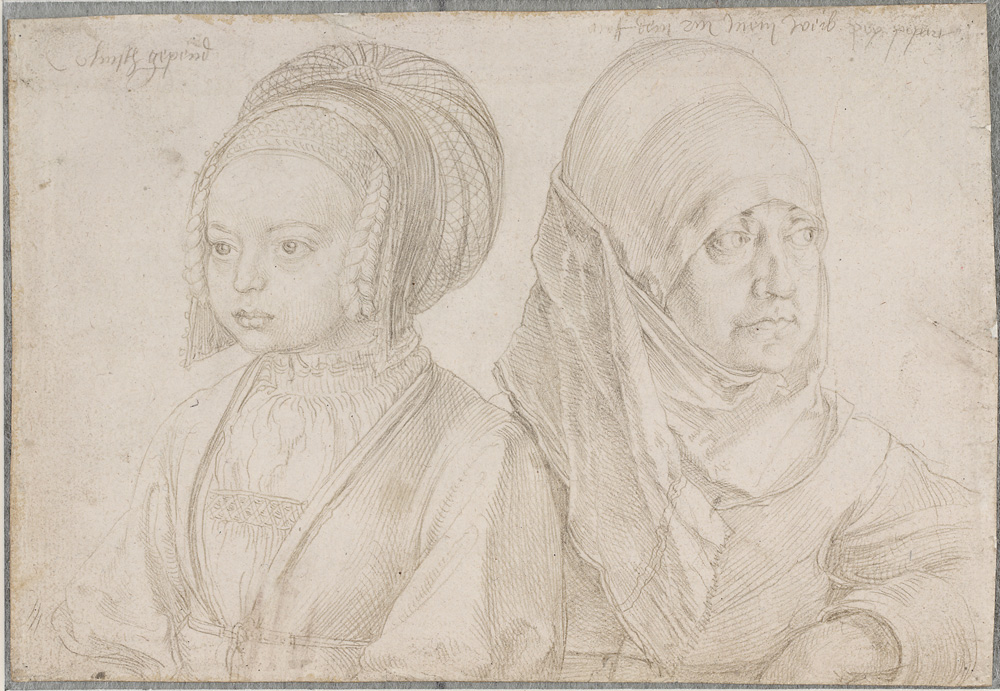
A silverpoint Drawing by Albrecht Dürer captures the regional headdress very well, and it has text to the left of the girl from Cologne, while there is text to the right of Agnes Dürer.
The text beside Agnes seems to be fairly consistently correctly transcribed as “awff dem rin mein weib pey popart” (“auf dem Rhein mein weib bei Boppard/my wife at Boppard on the Rhine.”)
However the text beside the girl has often been imperfectly transcribed. As written it appears as “Colnisch gepend.” Variations of the spelling can include “Cölnisch” or “gepent” this does not change the meaning.
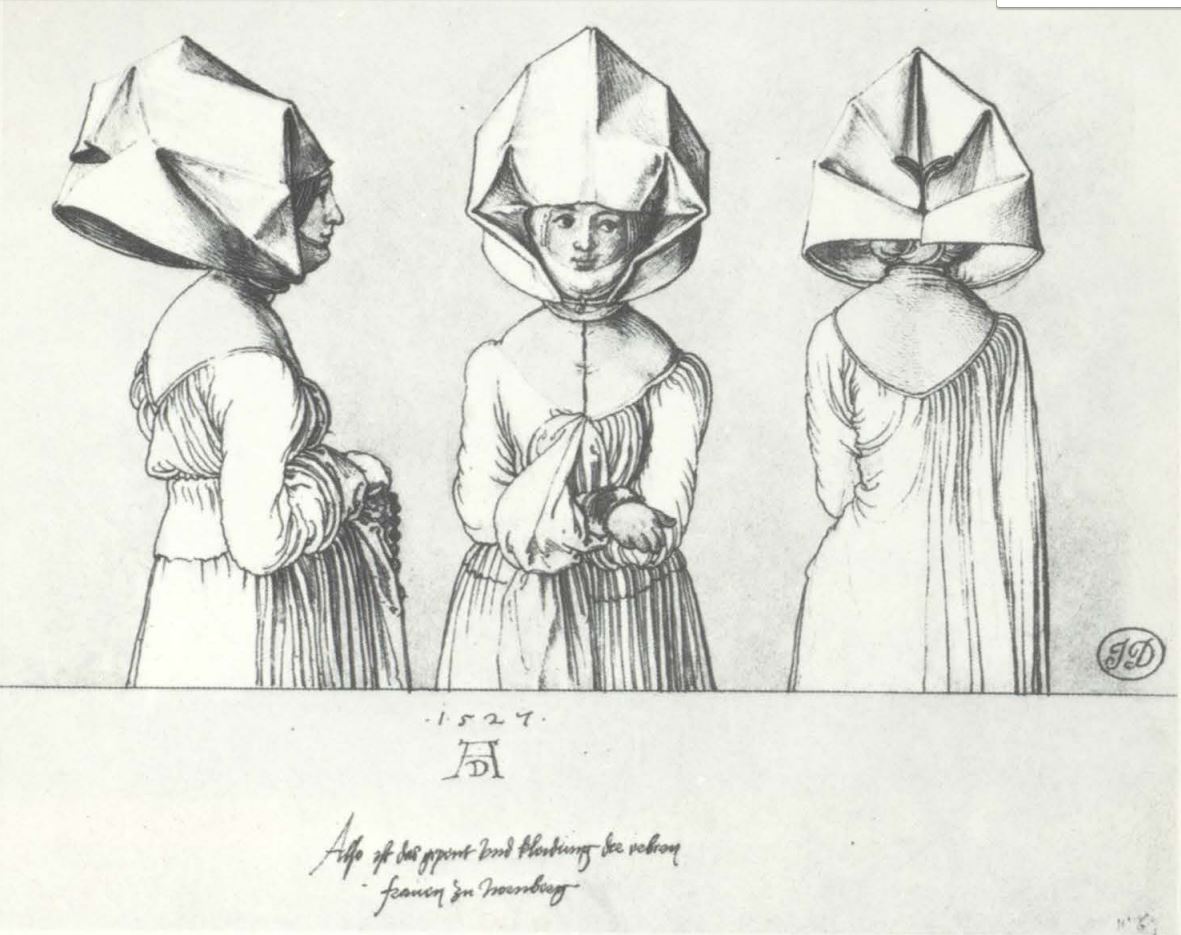
Another drawing by Durer of a woman in clothing of Nuremberg is inscribed “Also ist das gepent und kleidung der erbern frauen zu nornberg.” The headdress in that instance is made from plain linen carefully folded and pleated into a style characteristic of Nuremberg.
And the mothers’ robes / gowns fall from the treasure on the daughters:
Google translate, “clainat” : kleinod
.[Stirbt der Mann vor der Frau, so erhält diese] ir claider, clainoter, ring, kettin, Silbergeschirr, gepend, gest., verschrotten gewand. [Stirbt die Frau vorher und sind keine Kinder vorhanden] soll im volgen und werden ain tusent guldin haimstür . . . das übrig guot . . . sampt der morgengab, klaider, klainoter, ring, kettin, Silbergeschirr, bettgewat, gepend, gest., verschrotten gewand . . . soll ouch volgen und werden iren nechsten gesipten fründen.’ 1565, Z (Ehevertrag). S. noch Bd IV 1334u
[If the man dies in front of the woman, he receives this] ir claider, clainoter, ring, kettin, silverware, gepend, gest., Scrapped robe. [If the woman dies before and there are no children] should be in the crowd and become ain tusent guldin haimstür. , , the rest guot. , , sampt the dawn, klaider, klainoter, ring, kettin, silverware, bedweave, gepend, gest., scrapped robe. , , ought to obey, and will give birth to the next most clever. ‘ 1565, Z (Ehevertrag). S. noch Bd IV 1334u
(google translate)
[Montags nach Palmarum] [Montag 21. März 1524]. […] Soll ir auch geben ire klaider, kleinat und gepend. Actum montags nach Palmarum
[Erichtags VIIII. Augusti] [Dienstag 9. August 1530].[34r/105r] […]N. Arsyngers hausfraw: Item der ist zuegelassen worden, ire clayder, clayner gependt und was ir zuegehort, dem Maysentaler und dem jungen Mayr in behaltung weys zuzestelln.
[Mitwochs XII. Junii] [Mittwoch 12. Juni 1532]. Ittem er soll ir ire claider, gependt, pettgewandt, truhen und schlǔssl nit vorhalten.
However this use of the word “gebend” is not always understood outside of historic costume studies, and this is certainly true of many biographies and collected works. The most common translation is “bands” or ribbons.
It is probable the Grimm dictionary of the 19thC is the source for this.
GEBENDE, gebände, 4) bei frauen bänder zum aufbinden und schmücken des haares, dann kopfputz der frauen überhaupt, genauer mhd. houbetgebende, ahd.houbitgibenti serta, auch houbitpendil sertum Graff 3, 138. es heiszt aber noch nhd., landschaftlich bis heute auch einfach haarband (s. d.). […] es ist offenbar der aus der ältesten einfachsten zeit her fortgepflanzte ausdruck, der aber nun auch den kopfputz überhaupt,
in women’s bands for untying and decorating the hair, then head-dress of the women in general, more precisely mhd houbetgebende, ahd.houbitgibenti serta, also houbitpendil sertum Graff 3, 138. but it is still nhd., to this day also simple hair band (sd)
(Google translate)
The following works appear to use this translation.
“Next to these portraits, Dürer noted: “Colnisch gepend /… [Cologne ribbonry / …”
As this work also includes the costume sketch of the woman from Nuremberg as well on page 2356, it is unclear why the two items are not translated in the same way.
Die von Winkler an das Ende der Reise datierte Silberstiftzeichnung W. 780 zeigt links das Brustbild einer jungen Frau mit der Inschrift »Cölnisch gepend« (»bei frauen bänder zum aufbinden und schmücken des haares, dann kopfputz der frauen überhaupt«). Die Haube findet sich wiederholt auf Gemälden des Kölner Malers Barthel Bruyn.
The silver pen drawing W. 780 dated to the end of the journey by Winkler* shows on the left the bust of a young woman with the inscription “Cölnisch gepend” (“on women’s ribbons to tie up and decorate the hair, then headdress of women at all“). The hood can be found repeatedly on paintings by the Cologne painter Barthel Bruyn.
(google translate)
Auf der anderen Seite befindet ſich links das Bruſtbild eines Mädchens mit eigenthümlich aufgebundenem Haare, darüber die Worte: „Cölniſch gepend“ (Gebände),
On the one hand it shows the lion reproduced here, on the back a girl with a peculiar Haarbund)
(google translate)
Während des folgenden Aufenthaltes in Köln zeichnete Dürer in sein Skizzenbuch auf die Rückseite des Genter Löwen-Blattes (W. 781) mit Silberstift das Brustbild eines Mädchens und schrieb dazu: „Cölnisch gepend”, d.h. hier [houbet]gebende und meint de Bänder zum Aufbinden und Schmücken des Haares, den kölnischen Kopfputz.
During the following stay in Cologne Dürer drew in his sketchbook on the back of the Ghent Lion-sheet (W. 781) with silver pen the bust of a girl and wrote: “Cölnisch gepend”, ie here [houbet]gebende and means de bands to Tie up and adorn the hair, the Köln Headdress.
(google translate)
Yet another translation suggests it describes illustration being made at Cologne. Gepend appears in English-Dutch dictionaries as “feathered” or possibly “quilled.” However neither of these terms is correct as the drawing is in silverpoint.
“a girl with her hair tied in a strange fashion, and the words ” Colnisch gepend ” (” Painted at Cologne “)”
This doesn’t seem likely given the context of Durers own repeat use the term “gepend/gepent.” However it does lead to another discussion on searching through texts of early modern German/Dutch and in particular the regional dialect of the North Rhine.
At least one book that describes the work of Dürer does translate to the more generic term as it likely meant.
Technik, Metallstift auf grauviolett grundiertem Papier (W. 814 = L. 64) ; es ist ein kühles und sachliches Bildnis der Matrone, die noch einmal im Reiseskizzenbuch erscheint, diesmal vielleicht mehr, um ihre imposante Reiseschaube mit dem „Cölnisch gepend“, dem zierlichen Kopfputz des jungen Mädchens, auf demselben Blatt zu kontrastieren (Abb. 74).
Technique, metal pencil on gray-violet primed paper (W. 814 = l. 64); it is a cool and matter-of-fact image of the matron, which reappears in the travel sketchbook, perhaps more this time, to contrast her imposing travel mask with the „Cölnisch gepend“ the delicate headdress of the young girl, on the same page (ill. 74).
(google translation)
At this point more art history books use an inaccurate translation than an accurate translation, and as such is possibly contributing to some of the speculation about potential meanings behind the portraits of Anne of Cleves.
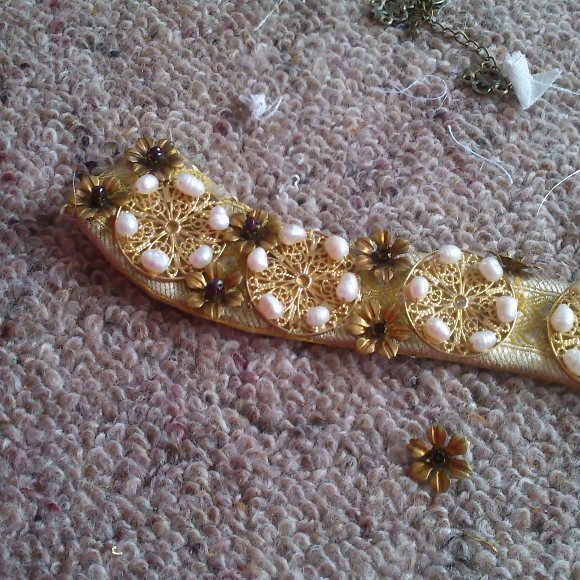
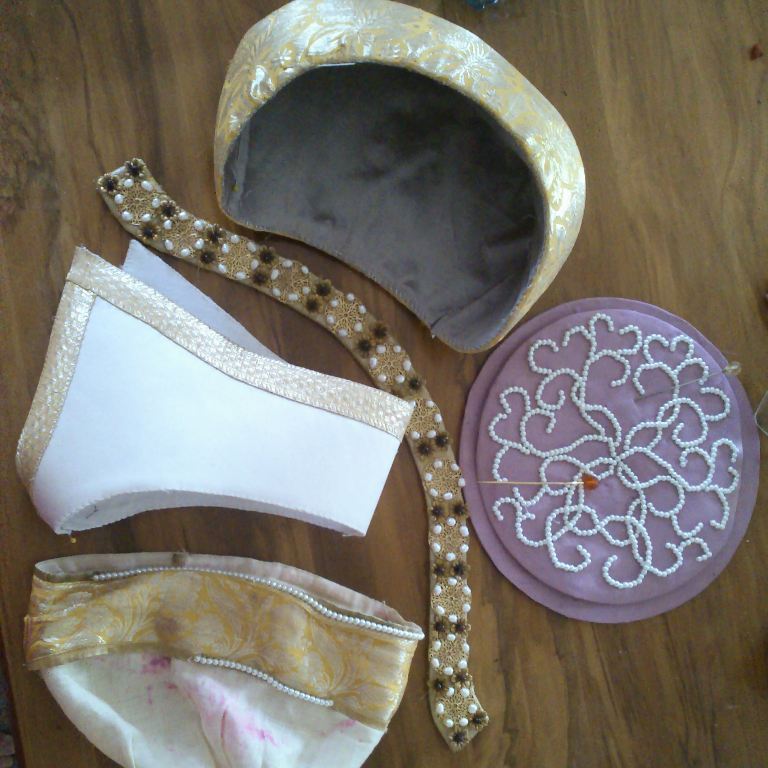
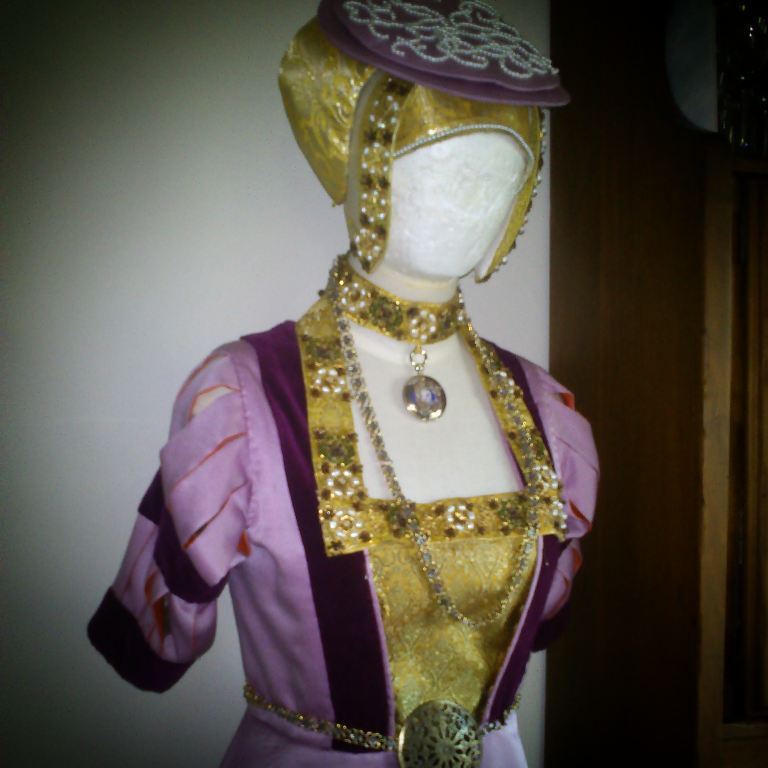
So I spent all of Saturday wiring small filigree pieces for my Amalia of Cleves ensemble. I was thinking of taking the velveteen off and putting brocade on, but then I may as well go whole hog and make the frock described by Hall for Anna. I have very big glass pearls to potentially work for the decoration. (I spend all day yesterday asleep because I totally forgot my body is in the chronic phase of my disease which means it’s a bit sneakier.)
I made the pieces match the rest of the pieces I had already made. I have run out of flowers but have a few different kinds.
And that is a smaller gold borstlap made more rigid I think it will be fine over my current front lacing leibchen/mieder/ and will work with a side lacing version too.
I’m finding more and more information to understand their clothing- most of which support of my theories- some were a bit out there but I seem to have been right :). In the mean time also better understanding about Cranach so that I can get that part of The Frazzled Frau back. (I have a cunning plan- it changes a little but I think I have it 🙂
Anyway. I am loving the pieces, and how I matched them, and stylistically they would pass with maybe a few “where did you get that from” if people got close. But ultimately I like them.
But I now have a really good feel for the scrolling shapes of the style, and have a few pieces that can mix and match. So I think it’s time to actually sculpt. And I may even be able to try something else that I think is very needed.
I think lost wax is the most appropriate method so that means making a silicone mold after sculpting so that I can reproduce them.
I want to do this part myself but will need help with the molding process as I do want these in metal so as to feel the same as the original- possibly be the same as many originals. If you ever go on ebay- take a look at the small metal findings of brass and bronze rings. There are so many they are actually affordable for collecting now.
I have my own small bronze seal that appears to have a squirrel on it.
Also I was going to do this in 3D. And I may still. I wasn’t sure how to do scrolling and petal shapes. Well okay actually I do know. I can do the basics in Sketch up and detail in But I do know how to carve wax to those shapes.
And it’s very exciting. But it means getting all my research up as I go or no one will know why I’ve done something the way I did.