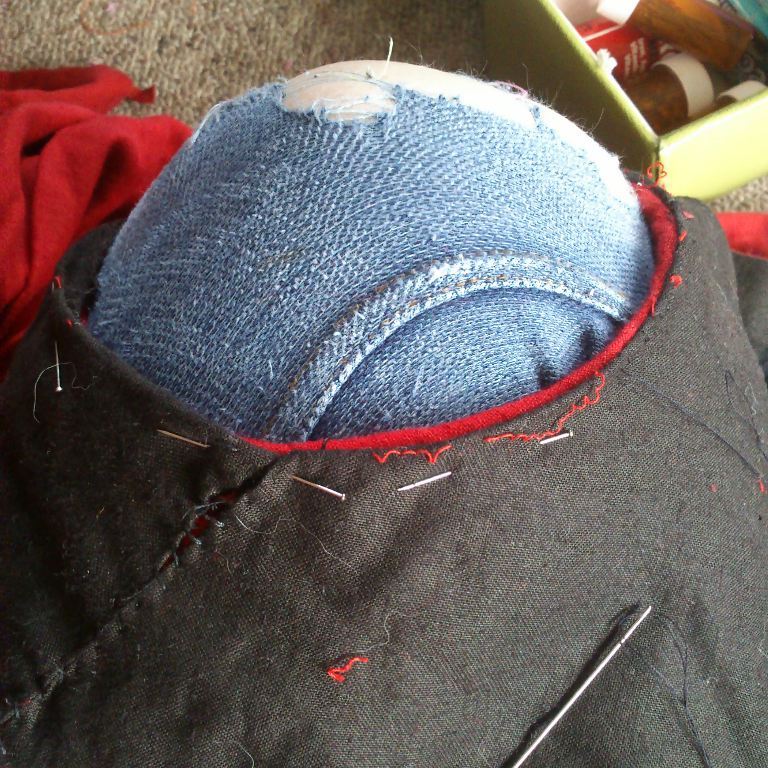
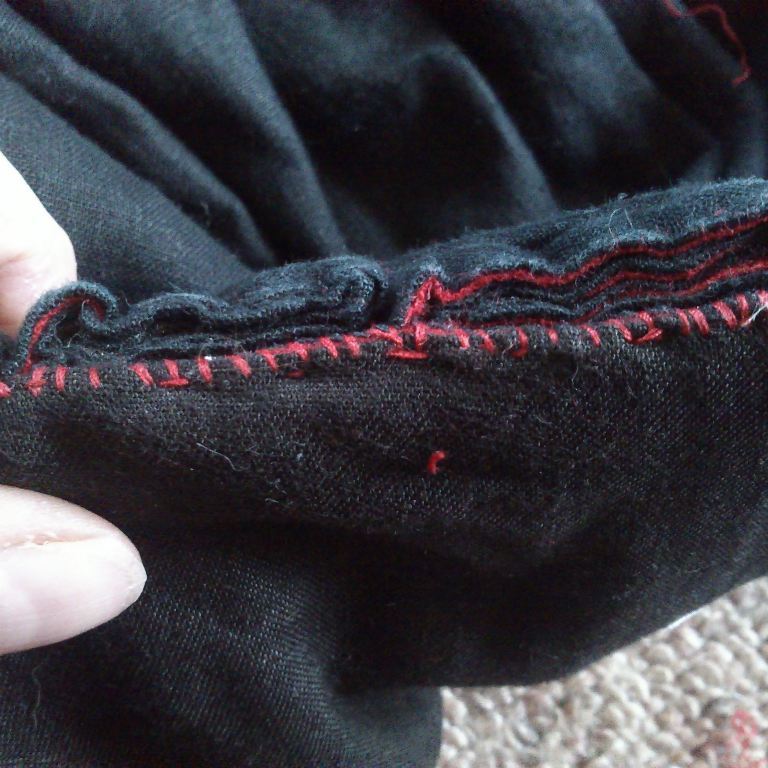
my pink cleves gown and some inspiration behind it

From Facebook: Emily Gibbs‎ to Canterbury Faire 2018, 29 January at 19:58 · Kaikoura Suburban, New Zealand

I am so inordinately happy with this! It has everything I love about the Cranach Saxon style with the weirdness of everything in the Nordrein (North Rhine.)

But it is weird. I’ll break down all the weirdness as I go but of note is the tone on tone. I deviated a little from the original, or rather combined two (three) figures in one. So the pink ground of two and the crimson velvet borders of another.

But tone on tone is very definitely part of this region, especially in the red/pink tones. And especially as velvet on a flat fabric.


Bildnis einer Frau 
Zuordnung:kölnisch
Datierung:um 1555/1560Sachbegriff:Gemälde
Sammlung:Köln, Wallraf-Richartz-Museum, Sammlungskontext: Stiftung Dr. Hubert Dormagen / Kerp, Inventar-Nr. WRM 3300, Zugang: 1980.12.31, Dauer: ab 1980.12.31

Kostüme der Männer und Frauen in Augsburg und Nürnberg, Deutschland, Europa, Orient und Afrika – BSB Cod.icon. 341
Publishing place: Augsburg
Year published: 4. Viertel 16. Jh.
Pages: 384
BSB Call Nr.: Cod.icon. 341
Project ID: BSB-Hss Cod.icon. 341
URN: urn:nbn:de:bvb:12-bsb00011752-7

Thuringen, I am not sure, Cologne (see what I mean by variations of spelling!)

So this is just one manuscript, and the Cologne image might be shot gold and red, but it is from the period. this is a hand drawn costume book, so little concern about it being coloured in at a later date. This work is full of pink as a main fabric. Full. But I am specifically looking for the tone on tone elements.

The Triumph of Maximillian is another illustrated book full of pink. But here again I have limited to tone on tone in red/crimson.


Title Triunfo del Emperador Maximiliano I, Rey de Hungría, Dalmacia y Croacia, Archiduque de Austria :… de quien están descritas y colocadas en esta colección las acciones gloriosas de S.M. Imperial, durante su vida…
Date entre 1501 y 1700?

Edition S.XVI-XVII Type Manuscrito

Subject Maximiliano I, Emperador del Sacro Imperio Romano Germánico

Page 96 and 97 and 97 again.

(these are huge zoomable images)


(Royalty Guide and Wikicommons respectively)

Sophia von Mecklenberg, married the Duke of Brauchweig, part of estphalia and so also has the mix of influences.I did not know of this image until today, however I am familiar with the two pieces of stonework depicting her in a very similar dress- I had it set aside as research for the sleeves, this confirms that the sleeves are weird, hooray! She was buried in Cell an

But the colours are nearly identical to my frock 🙂 So that is exciting. I was working with a limited range of fabric.

I knwe of her through the following images from Bildindex (handy hint, grabmal is a great search term for looking for images


Grabplatte der Herzogin Sophia von Mecklenburg
nach 1541 Grabplatte, Grabskulptur,  Sandstein

Standort: Celle, Kirche, Evangelisch-lutherische Stadtkirche Sankt Marien, Chor

Gedächtnis: Sophia (Mecklenburg, Herzogin) Herzogin Sophia von Mecklenburg war die Gemahlin Ernst des Bekenners

Also a full 3d view


Epitaph des Herzogs Ernst des Bekenners und seiner Frau Sophia, Herzogin von Mecklenburg
Cornelis Floris (2) (Werkstatt) 1576 Epitaph, Grabskulptur Alabaster

Standort: Celle, Kirche, Evangelisch-lutherische Stadtkirche Sankt Marien, Chor (Nordwand)

Gedächtnis: Ernst (Braunschweig-Lüneburg, Herzog) Gedächtnis: Sophia (Mecklenburg, Herzogin)

So side track aside there are many more examples of red based tone on tone garments of the wider region.

 
Both by Noclas Neufchatel.

Brady hart Gallery and wikicommons and liveinternet respectively.

These are of course from Nuremberg and so are quite a distance, but we see the range of tones for tone on tone (also the red dyed braids!!!)


1516 Circle of Hans Holbein the Younger (1497-1543) Portrait of Dorothea Meyer, wife of Jakob Meyer zum Hasen (Basel)

From Barbara Wells Sarudy’s post about winter clothing

Kunstauktionshaus Schloss Ahlden GmbH 2017 

Christoph Amberger
(Um 1505 Nürnberg – 1561/62 Augsburg) attr.;
Portrait der Maria Hieronymus Sulzer

This is much more suble, and leaning towards the crimson on yellow seen at about the same rate.


saxon maybe

I was going through my folder of illustrations and I am not sure if this is an illustraition or wall painting. It certainly has the qualities of translucency seen in illustrations.

But I would dearly love to see a group do this. I have a love of the black check border- some more examples in etchings that I know of as well as the girl with triangular decorations on her cuffs. But really. I just think this looks like a group from the old h-cost/lj days.

I’ve been sharing to IG today some of my older photos. You can sort of edit images in Chrome if you “inspect” choose one oft he mobile devices, refresh, and upload. Editing button is on the right and allows you to zoom centrally or full width and you can move the image, or full height. I have “inspect” set to Nexus 6 right now.


Anyway. So I realised how long it has been since I started down this Westfalen route. I moved into 1560s Koeln due to the ability to basically copy straight from the de Bruyn book. Since then I have enough courage to create my own garment without copying directly from an era where I’m mainly working with allegorical paintings and text. So that is really cool. But yeah, the de Bruyn book is literally able to be copied line for line for the Dutch-German areas. I mean it’s so accurate as to be something I’d point people to and say trust your gut because this artist knows what he is looking at.


But also while sharing I’ve decided to say Fork It. I love pink. And I love blue. I’m going to let myself wear both. So my current frock of frockness is raspberry on baby pink and I have accessories to match. So a book has been recovered and my pin book now has a cover. Woot! But next I need to decide on how to handle carrying my items around. So I think I’ll grab some more of the velveteen and add another border to my dress and use the excess for a hat and for a scrip bag.


A single layer of black wool twill (super fine, not a gabardine and not quite a satin) for my heuke.

This is the kind I need to make. I think the weird shape is pleated. Think of a paper plane and I think that is pretty close to what is going on.

This is what only Koeln used. So annoying as it’s perfect for shade and rain protection. Also it just is super out there.

Duerer’s drawing shows a half circle with a half circle cut out, but that is an actual dutch style. I think the half circle cut out is gathered to the duckbill shape seen further west. So time to dig a bit deeper for what was going on in the Duchy of Cleves because I believe de Bruyn on this point. Heuken were very much shaped by regional preference.


Also this portrait was what really got my inspiration for my first Nordrein gown in 2004, but this is also tone on tone, and, and, red velvet is everywhere in inventories. I men every where. Mainly for sleeves and bust decoration. This tone on tone thing though? I love. So that’s why I was okay when the store had no black velveteen and only raspberry.

so pink and crimson works

Yesterday was a bad luck day. It started with a health wobble (very old one, and it was definitely a whole lot better than it used to be) Mr Carlo going missing, rain, pale mamma duck lost one more duckling, I couldn’t find the glass jars I know one of the cheapie stores in Westfield or outer shops has, then my rheumy appointment was cancelled as I was already out there and finally Spotlight did not have any black velveteen which is what I wanted my pink Cleves gown trimmed in.

But they had a very dark maroon-crimson which actually I really do dig as a tone on tone type of deal. The colour and texture is definitely found in inventories- mainly as sleeves- and also in some illustrations. So I really only am unsure if that specific combo is okay. But the Duchy of Kleves, Julich, und Berg was much brighter and more in the Saxon mold than Cologne which was a free city and thus did not have any aristocracy and so portraits tend to show much more sober colour schemes. But I have seen a sort of lilac, lots of warm and cool red, and even a yellow gown on figures representing real people. Religious figures then to have much more

It also ended in Mr Carlo rushed to the vets as he was dealing with septicemia. He is a tiny kitty, about half the weight of any other cat I have met. So he is more delicate than he thinks and injuries are a lot harder on him.


Today we were hit harder by the storm and pale mamma lost all her babies in the wind. But she has just brought them around again a few hours later. Mr Carlo is a lot happier, he is liking pats and even tummy scritches. So today is much better.

I even finally scanned my passport photos and finished my online application so that is great.

Also Mr Ginger Fluff is sheltering on my bed from the storm. He is finally starting to properly rest.


So I feel okay about sitting and sewing today.  It’s been a slow morning for the above reasons but it’s still productive.

more clevische kleidung

Today I got my lining put together and pinned into the pink Cleves skirt, reshaped my hulle and steamed it into a nice curve (yep, millinery, so much steam and pressing and more steam and the stink of ammonia, and lanolin, and and more steam.) I have set it aside so I can make another pressing shape as my wulsts are really squishy.

And I did manage to tidy some of my inventory files. It’s still heavy on accessories other than hats and garments other than gowns. Which are you know, the most important part.

But I may also have a lead on looking for secondary texts. Gewand is used a fair amount so I’ve been brute force searching.

Meanwhile I do need to actually put those files in their proper places and transcribe them.


Of course the very best files are photos of documents but they are not of a resolution that I can read them. Which is annoying.


But, that is a lot of ironing of line lining and wool hat so… i’ll get that put away and get the files in place.

more gear from mina

(Mina is the shortform of my SCA name and tends to be used just as a nickname for me- I like it 🙂 )

I just grabbed a set of a knife and fork from Trademe- mother of pearl handles, silver decorative join to the functional end. Not suse the content of the functional end.

They are really lovely, and fit what I wanted 🙂

I want to make a case for them. So it means having them in hand sooner rather than later 🙂 I am not entirely sure how they are made but I have a few options to work with.

So, why a knife and fork? Aren’t forks out of era. Nope.

My favourite set ever is Italian and is made with rock crystal.

http://collections.vam.ac.uk/item/O112430/cutlery-set-unknown/

It seems to have been redesignated later than 16thC but there are similar that are earlier.

http://gyujtemeny.imm.hu/gyujtemeny/kes/1434?i=1377

https://commons.wikimedia.org/wiki/File:Wien_Schatzkammer_Deutscher_Orden_-_Essbesteck.jpg

So I originally tried to find modern cutlery I could adapt, but Most just cannot- I need each end to unscrew and have a core to thread crystal on to.. So a look around at further designs:


All from Bildindex, info in photos. All 16-17thC and across the states.

So my theory is that we don’t just see sets of knives in the Trachtenbucher but possibly knife and fork sets.

Mostly the forks are long tined. I personally do not want to run the risk of poking myself in the face with them so I am fine with a smaller tine set further to the end. In the first image there is a case that may be associated witht he matching set.

But now for the cases:

https://www.bildindex.de/document/obj05227007 https://www.bildindex.de/document/obj05227006

These could well be wedding knife sets. There don’t seem to be a top end to the cases. And they seem to be silver.

These do appear to match the sets worn in the trachtenbuch.

These are from Weigel’s book https://commons.wikimedia.org/wiki/Category:Frauen-Trachtenbuch_(1586)

https://www.bildindex.de/document/obj00290368  and https://www.bildindex.de/document/obj00290368

These are from de Bruyn.

These appear on both unmarried and married women, so I think these are a status symbol- I found single knives in cases on working women though.

So, any evidence that these are knives and forks:

https://www.metmuseum.org/art/collection/search/210073?rpp=60&pg=1&rndkey=20140327&ao=on&ft=*&where=Europe&what=Knives&pos=38

This is later, but the case and cutlery are a match.

And

http://www.britishmuseum.org/research/collection_online/collection_object_details.aspx?assetId=1477461001&objectId=35872&partId=1

c1600.

Yes! I can make a case like this from the scraps of heavy russet I have. I think I’ll need to learn some techniques from shoemaking as I’ll want really crisp edges. But I’ll be able to embroider the case 🙂 or… I still have diamon shaped brass stampings I used for my Valois ouches set. They could be shaped to fit.

Anyway. Yay! Now I need to find a matching spoon to carry in my purse 🙂

another wrinkle sorted

I have been trying to work out a way to have fancy chemise sleeves as per my Cleves dress and just was getting very lost. Until I remembered that I already have the solution. pins!

This is my c1560s woolen Cologne gown. This is taken pretty much from the de Bruyn Trachtenbuch. So the skirt overlaps at the front to allow it to be worn open or closed. The sleeves are half length with matching hanging sleeves. The sleeves are actually half length and then matching hanging sleeves pinned on.

This is not totally interpretive. Hanging sleeves are listed separately in inventories and it is possible to see the pins in the woodcuts.

(A. de Bruyn, citizens from Cleves.)

Okay so they look more like thumbtacks here, on the far left, but that curvy line is also seen in obviously pinned on fitted sleeves (also found in inventories.)

Note also the watered silk lining on the far left. And what is a likely glossy lining on the far right. Note the turn backs of the sleeves and skirt. And the short sleeves over fitted sleeves. This is a fantastically modular wardrobe,

(A. de Bruyn, citizens of Cologne)

So you can see my wool gown is much more Colone in style but uses the Cleves plate for the pins information. I think other plates show pins used horizontally, which is how I use mine.)

The sleeves for my earlier Cleves dress are probably held on in a similar way. I’m assembling my current cache of images and documents to see if it does have support not just makes sense. It is also helping me figure out how to use my decorative under sleeves as well. No one puts brocade or heavy embroidery on something direct to the skin or part of a washing chemise.

So, very excited, I’ll be able to make more sets of hanging and under sleeves for my earlier dresses which makes them possible to be worn for a week long event.

anna meyer dress and more stitching musings

This was one of my earliest forays into handsewing. But I am not entirely sure I used the right fabric (a very fine tabby wool that feels like there is a tiny bit of overtwisted yarns to make for a slightly crepey surface.

But I do love it. But I have to accept I’ll never do the embroidery needed. I already gave away the Cleves inspired redo of the underdress (dyed it baby pink, it was very cute but too short for me really).

There are definitely lots of examples of finely pleated skirts and aprons of single layered fabric. This has been interpreted as linen when white but what if it’s not?

There are more extant pieces coming to light and one of them is a set of fine sheer silk with silk lace cuffs and collar. This makes me super happy as it is a great match to the silk organza I have to make a few sets of super sheer items.

But it does make for a bit of a new look at the inventories I have. There are lots of little pieces of cloth, not entirely always where they would be expected to be in lists of things. Also of course there is not a lot of consistency in spelling so basically I’m sounding words out and trying different levels of force. C/K is an easy spot, but G/K/C is closer to the interchange.

This year I have not devoted enough time to keeping all that fresh in my mind so I’ll be bringing it all with me to Canterbury Faire as well as some for public consumption parts of my Schnittbuch.

Okay, so I know of 19thC sewing books (stitching for linen goods and embroidery) and of model books. Also the tailors manuals. I think I have copies of everything possible (Including snippets from a Polish pattern book and the Milanese- both of which I’m still hunting down the full context.)

Does anyone know of books of stitching pre 18thC? I can understand the oral traditions of passing down mending etc. But there were people teaching sewing, either to professionals or for leisure. So, there has got to be a hand written book somewhere? There are glimpses in books of trades but it’s sort of tantilising rather than answers many questions.

Some of those woodcuts though are amazing in showing construction (especially on the insides of collars or near a fastening. They correspond well to extant garments, so I think I would be pretty trusting of a tradebook printed that shows stitches.

I’m working towards producing my own book and so I would like to try and make my illustrations look like they come from the location (lots of printing in the area so that’s possible.) Working from the work done on extant garments is a big part of this. As is practicing line art. I have some lovely fine pens and they do seem to help. My hands are less sensitive now so it can be difficult to write or draw. Also my hands simply don’t bend in ways that help in this 🙂

cleves overhaul continues

I am giving serious thought to changing the shape of my hembden (shirts.) There are enough finds and illustrations showing plain linen garments worn directly against the skin. It’s not a terribly easy task to figure out how I want to do this, but remodelling garments like these are seen also.

Given the Cleves region kept hold of the tappert style (houppelande) for so long, and the underdress, it seems likely that white linen goods may have as well.

The style is very much about curves, it’s somewhere between Saxon and houppelande (which sounds weird but there it is) so there is a fair bit of fit in the underbust to waist and then softness above and below.

A full hemd adds bulk to the waist so I need to at least narrow mine a bit. There are a few options. But the Lenberg finds show fitted linen goods and there are more.

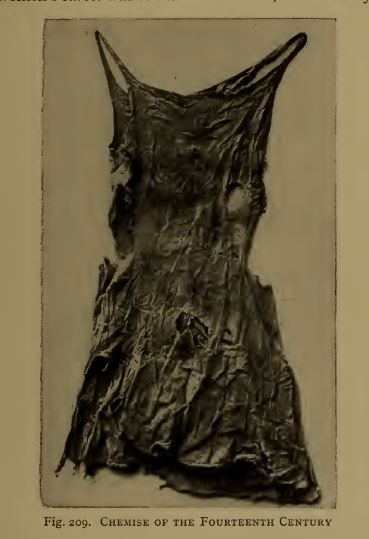
This is a 14thC chemise from Kohler’s History of Costume. Not credited in the English version. I thought I had a copy of Practische Kostumkunde.. but I’ll keep checking.

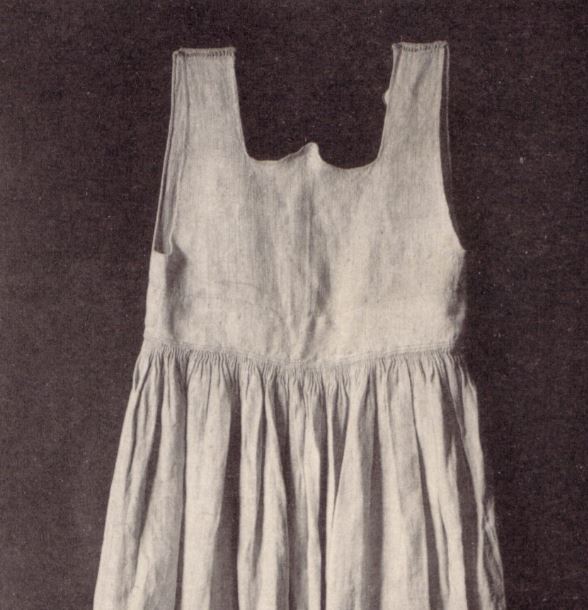
This is from Der Renaissancefund von Poysdorf I may be able to get the full article on ILL, but if you live in the US you can get the full journal it is from from HATHI Trust, Werke der Volkskunst, vol. 1. It’s described as grey linen, and one of the many books my brain has chomped through suggested that grey linen was especially used in clothing for the poor, via the church. I’m sure this is a single layer skirt and bodice but with a very wide waistband- possibly created by turning up a very long seam allowance, possibly allowing for continued use from young age.

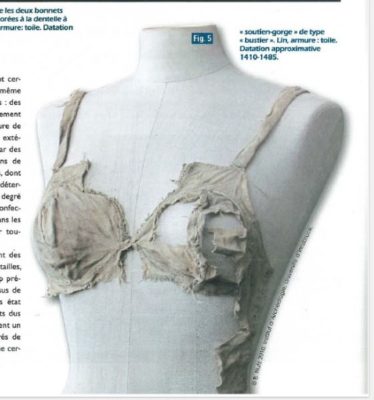
This is one of the Lenberg finds and this photo is specifically from the Academia online copy by Beatrix Nutz (huge thank you to all scholars sharing their works this way.) (edit- removed the garment that is a lining, so as to not confuse, see Marion’s comment below. There is so much work to be done on these finds, also there is a scrap of yellow silk that is juts.. I want it.)

Des braies et soutiens-gorge au XVe siècle… Une incroyable enquête au château de Lengberg. In: Histoire et Images Médiévales 30, 2012, 20 – 27.


So here we have all fitted, semi fitted plain linen garments. Basically controlled fullness is the aim here.


I do want sleeves to protect my garment sleeves,so I do need to figure that out.


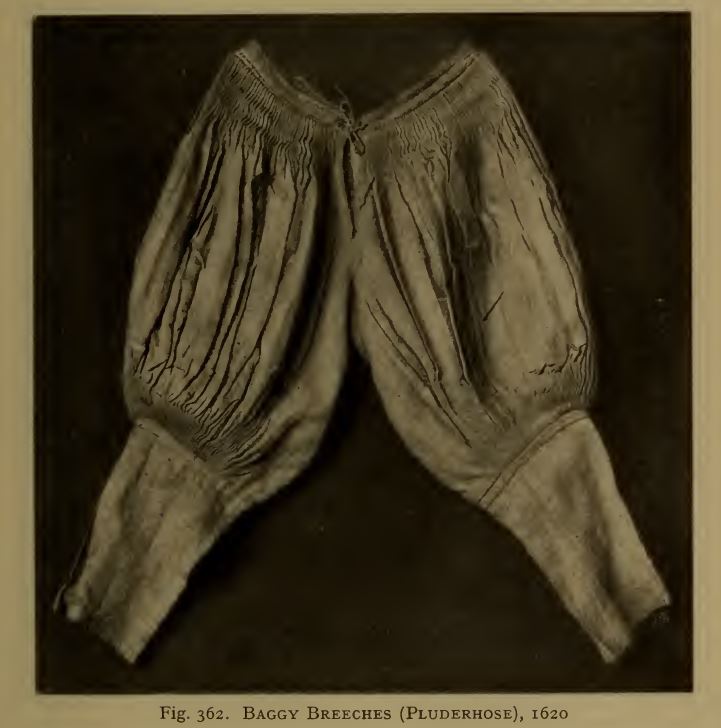
Also, this is not quite the same but a pair of what i think are linen hose, the calf is very fitted, there is a waistband and the fullness is maintained where needed.

This is not really the best scan of this book, but there is a very clear under layer aspect to them, the fitted calves would would under boots or hose really. It’s still an example of a fitted and full section.

cleves redo

I am remaking my linen Cleves/Cologne dress into a simple kirtle. To do this I removed the half length sleeves and turned the seam allowance under. I over handed the red linen and canvas layers to the canvas layer, then turned the seam allowance of the black linen lining and overhanded the edge to the previously turned seam allowances.

I also unpicked my overhanded waist seam to move the overlapping skirt edges to line up with the fastening end of the bodice.

I will need to cut down the neckline as the high curve is after 1550, while a slightly dipped square neck is more appropriate pre-1550.

Otherwise it’s very much the same- perfectly round waist, skirt fullness directed to the back. Side seams that appear to be in line with the back of the arm, very stable neckline.

Later the bodice appear to lengthen a little but it’s actually more to do with a more vertical bodice line- once you pull the body in tighter the bust is raised and the neckline creeps up. Narrower shoulderline completes the apparent lengthening.

Ideally that is 🙂 In reality bodies resist most extreme changes so I ‘m going to remove the hooks and eyes and add lacing rings so I can leave the kirtle open a little in front to soften the torso shape.

The skirt front gets an additional pleat that points to the back to reflect some of the artwork in costume books of the time.

crafty cleves christmas

These times of the year are both intensely personal and about community. Today I will be spending time with my mum and with friends. And we will create 🙂

So far I have taken a pattern from my woolen kirtle to remake with a linen lining- this is based on on the extant kirtle in Patterns of fashion as it is very comfortable and I am going to try and see how to lay it out for best fabric use.

I also made a basic outline for my schaube, mainly to check I have enough fur to cut all in the same direction- it seems so.


After spending a day yesterday sorting out some of my many old Frazzled Frau files. I still have about 1000 distinct images to sort, I am going to see what pearl designs I have that can be used for my new Cleves cap. It will also be used to decorate a brustuck (oh.. oh! I think I have something to follow up here.)

So I need to set up my frame. I think I will want the full frame up so I can possibly pearl several pieces in one go. Or just my little ones… let’s go see.


Oh! And my linen bleaches super fast suggesting that yep it really is linen 🙂