final post of the year

I was going to spend some of today transcribing (lists of headwear) or playing SWTOR and I can’t.

My entire life didn’t just pause this year, it went backwards in many ways. And in ways I have not been able to recover from.

It’s possible to be grateful for what I have, while being so aware of how very different it could be. And will be at some stage again.

Inspiration

I’ve not had a great time finishing projects this year. I keep switching to my short and/or easy projects but when I can’t finish them, I wind up in a worse headspace than before.

If I’m struggling to cover the legs of my frog purse, I say to myself, how can I possibly work on my pearlwork? How can I possibly put the lining into my gowns? How can I possibly figure out how to break down my larger projects into smaller when I have utterly failed so much in so many ways?

The secret was to put my jewels back together for my Anne of Cleves. This set has taken me so long to paint (24 hour drying between layers, then they needed baking carefully) and to even find and afford all the parts.

But they are done. 36 in total. I can make two more, and I think I will.

It took two days to wire them, in short bursts. I think what made it truly work is that I was able to wire the flowers first, and each one was a distinct unit through both passes of the wire.

So I’m also now able to look at the rest of the jewelry today (the big daisy pieces, and the rainbow collar.

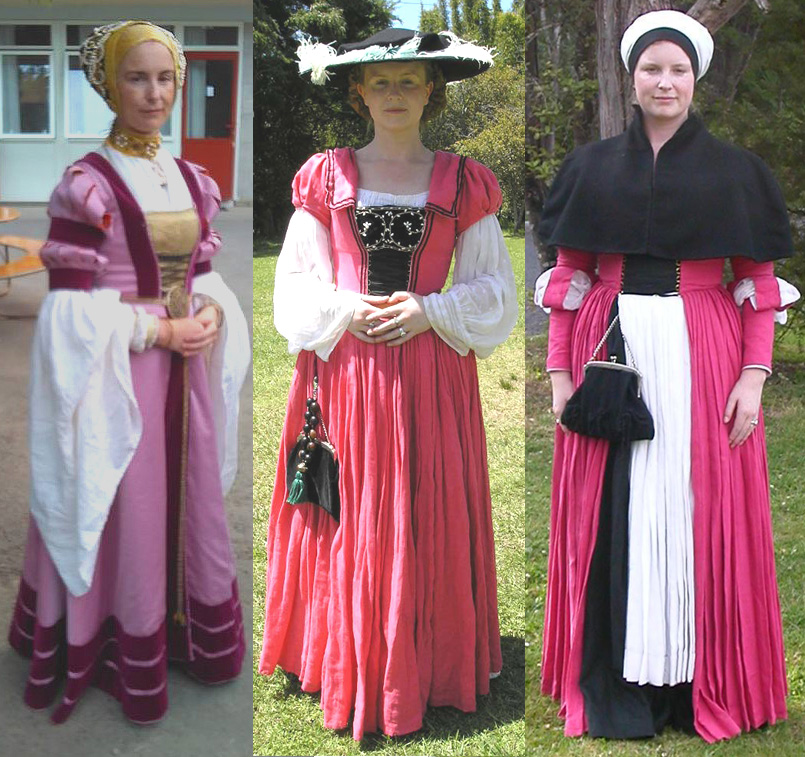
But I also have been using a few days, with more days in between to be fair, to cut skirts for my Juelich dress and Cranach dress.

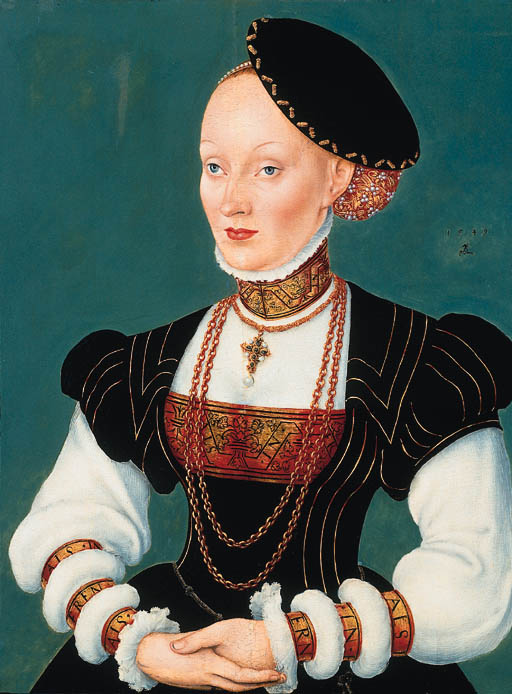
And I did use my understanding of the extant garments to pattern a really nice toille for the Cranach and today I made a toille for the sleeves that I really like. The actual painting is frustratingly two shades of oranage! But I’m making it in pink because it does look spiffy in pink.

The two dresses use nearly the same pattern. I used my half circle skirt in gores to cut the front of the Juelich dress, then overlaid the “front” and “back” (they are the same shape) so I could get another 8″ at the side of each waist which then created I think anouther 16-20′ at the hem.

What’s really handy is that you can then pin the bottom layer of pattern and use the upper to fold to match the shape of the pattern that flows over the edge of fabric. And then you can either pare the excess back or extend it based on how much fabric you have left over.

I did mess that up for my first pass, so I got a little extra to cut a new skirt front for the Juelich to be as full as the Cranach (but the direction of the pleats will give it a very different look.

And so I have enough from the original skirt panels to gut the massive sleeves of the Cranach.

I think I’m okay

I think I did indeed manage to time both pain relief and steroids to prevent a flare, and with minimal side effects. Though yeah.. prednisone makes me a bit.. over active so I wound up not sleeping until about 2am.

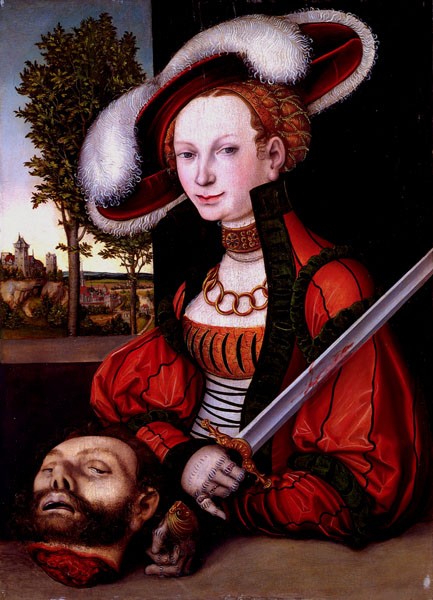
But today I have cut the replacement skirt panels for my Julick gown meaning that yes indeed my favourite Cranach frock is back on the cards!

Judith with the head of Holofernes

But in pink and black. Yeah. Very excited.

I am still pacing myself. I have to. I need to get my book updated as I update patterns.

Super nifty to find all my Spanish tailoring patterns ready to go.

But I have a little more tidying and record keeping to go.

avoidant behaviour

This year has brought a lot of stress, and with it has been a need to stay not just up to date but be proactive. So this has taken a lot of time and focus.

On top of that is a long trail of undiagnosed and uncontrolled fibromyalgia and after a few years I have started to be very stressed by what normally is my joy. It started with me trying to push through fatigue and making decisions in cutting and sewing that have had to be undone or left me wasting materials, through to now where I am putting off or avoiding working on my projects as I have learned that I will make mistakes.

I have been working on this. I really have. But it’s not a simple situation so the solutions are not simple.

I can’t stay in one position for long so I do indeed switch tasks. But then that doesn’t let me settle in. I don’t really have long enough to transition between skillsets.

And if I move from say tidying files at my PC to a little lightweight hand sewing, to cleaning, by the time I come back to tidying files I may not remember what system I was trying to sort by. I need to rest a lot, so that separates each round even further.

So by now I’m full of doubt.

Doubt also has a habit of seeping out of context and into everything. So yes at this point I’ve started second guessing everything.

Oddly though I’m still somewhat positive. I just wish I had more time in which I could work on every aspect of health I need to.

So exited I forgot to say why

I can focus on my Cleves frocks as well as research. One of the patterns I am working on is how best to use my Sator Cranach fabric for my Anne of Cleves dress (the Bruyn portrait.) It’s really wide fabric, and I think I can get the three rows of skirt banding cut from a specific section, but I really need to figure out the direction of the weave specific to the portrait.

It’s somewhat easy to find a lot of painting by Cranach to find the prefered direction- very easy. But Bruyn? Much more difficult. Given the painting was missing for about 70 years that’s understandable.

It’s just very difficult to figure out the direction for vertical guards. The hem, fine, but the skirt opening? I’m not sure.

It seems very wasteful to stick to vertical to vertical and horizontal to horizontal. I do at least have the Mary of Hungary dress with the clear direction of the brocade. Only around the neckline, but it does support my theory.

I’m using other extant garments for these, so I need to get all that documentation sorted too. There are some nifty linen and hat items that need to be transferred to my new site and catagorised at that. Posts or pages? Tags or Cats?

So. Rest and recovery and then time to get a copy of the Cranach design put into a digital scale copy of how much fabric I have and then I can figure out where to cut what. I have a gorgeous saree made with metal yarns I am so tempted to overdye black to see what I can make from that. I should be able to just use the Procion, I am not sure if it is rayon or silk. I can do a test with a bit of bleach as silk will disintegrate within minutes.

If it works it may wind up the better choice with the velveteen.

And I need to wash all that fabric. Might start with the velveteen. Then calico. Then wool. I’ll have figured out how much wool I need by then I think.

So excited

Yesterday I was able to have my second pulse of Rituximab- it’s getting really difficult finding a vein that has a nice clear 3-4cm straight- and wrote a lot while I was in hospital. A. Lot. A lot a lot.

All about clothing of Cleves.

I had also sorted my pattern book patterns, with my personal ones, to work out the order of my book, and I’m so much happier with how to go about that.

So today I got the rest of my mini patterns in one folder- all garments I have made, some patterns finalised, some rough as heck- and another folder of all my reasearch notes for costumes- including more rough sketch patterns- and finally my pattern book into another folder.

It’s a lot of work but it makes sense now.

My velveteen for my next pink Cleves gown arrived, as did the block of beeswax (yay! I can clean my bee shaped beeswax and keep it as it’s so pretty) and have already repaired our doorstop- a rhino made from heavy corduroy.

SO EXCITED!!!

Cleves frocks? CLEVES FROCKS!

I have a Thing for pink! Last week I was able to pick up 7m of a lovely fuchsia pink wool, enough for two frocks.

Now I do indeed have a pink Cleves frock, and I am sure I want to make another (with black guarding, then maybe take the raspberry velveteen of this pale pink, move it to a yellow silk, then use another gold fabric to guard the pale pink.)

But I am not sure what to do with the rest! I could remake one of the other two frocks above, or I could make my favourite Cranach frock ever.

Judith with the head of Holofernses, by Lucas Cranach

I adore everything about this particular version. And it would be lovely to finally make it.

4.0.1

But this is the portrait that inspired my second pink frock and that turn down collar and short sleeves make for a really easy to wear in summer frock!

I could in theory make all of these.

The linen mix fabric I’m using to line it all has mercerised warp threads. So it’s very glossy.

I also happen to have enough to line two pink wool frocks and then enough left over to make a self lined frock.

Most of my linen does not mimic the cvolour or texture in imagery, but my very cheap mix does.

It then really is a case off how many short sleeved pink frocks is enough?

progress for the week

I’ve been so overwhelmed by my own unfinished projects that it’s taken a fair bit of work to focus. Especially as fibro yesterday took several different approaches to pause it enough to prevent a full week flare. I might have managed it? But I’m about ready to take my glasses off and carefully not prod my eyes.

So I have managed to get both short chemises cut down and partly sewn ready for stitching the collars and waist bands.

I’m using some extant garments and also some images to make these. Where I have deviated from both is a reduction in the material in the back. This is in part due to trying to reduce heat and partly to reduce bulk.

The neckline of my new Cleves wardrobe is a shallow V in the back and wide at the front. So this means the linen undergarments don’t need to be full except where they are exposed. So this is at the front neck and at the wrists.

I’m happy with my reasoning on this, but I really want to actually test drive the idea over the course of an event.

All my linen and support gear is being rebuilt. Again based on a mix of extant garments and imagery, but also text. The documents I have, mostly shared already, tend to be much easier to use to figure out garments made from shell fabrics- wool, silk- with a few garments named after fabric- sarrock- while linen garments are rarely detailed.

This has though been useful in many ways.

But it does mean a bit of guesswork.

So far I’m very sure on a lot, but the “little” chemises could be interpreted in a few ways. “little” is used a lot (“-gin” suffix) but in many ways. Usually for a child, but all over the plac e in garments. And also in jewelry.

So I’m hoping I can pop between my written sources and my own garments, and my pattern book this week when I can.

Resting is frustrating when some parts of me are keen to go, go, go while also being bordeline pain in many others, and then with fatigue as a haze everywhere.

pattern book update

I really have not made much progress on anything this year, very distracted, but today I managed to reorganise my pattern book paper files into a good and straightforward order. The book keeps growing because despite how quickly I can pattern and cut, it did take a very long time to get to that point. And imagine how much I could have done had I just been able to find that all in one place.

So I’m basically writing a book simplifying all stages, allowing for the kinds of compromises we have to make when recreating. So I’m starting with some basics. And all based on engineering. So I’m explaining what a stitch offers and what it is often used for.

I started my own costume making from 19thC construction methods. It’s actually really handy, but it’s really quite different from modern pattern making and construction that I have often been perplexed by a lot of reenactment/recreation terminology. So I’m not just trying to write something that could have been written in the 16thC, but to not skip over 500 years while also not over complicating things.

I am having a bit of difficulty in making sure my work is inclusive, so accessibility is a big deal- alt text yes, making sure that makes sense is a very different thing when being very specific for pattern drafting. But my text is also meant to describe what is in the image so I’m trying to not double up on text reader work. So that mostly means doing a bit more research on how technical manuals and geometry books do this. And of course also looking up reviews.

I also have built all my patterns on me. I happen to be a really close match to some extant garments but that mostly means I don’t have to do much in terms of proportion. But again, I have all the tailoring books, all the extant garment patterns I can get, and all the paintings of different people in the same fashion.

So that has also changed how I treat my construction notes.

But both RA and Fibro are Doing A Thing. My joints are very stretchy in some directions and none in the other. So my ankles and wrists at night need support so they aren’t overstretched. Which sounds strange right? At night though those joints can be overstretched for longer time than I would choose during the day.

So it’s time to apply heat!

Anne of Cleves- why?

Many years ago, when the internet was still a fairly quiet place of free sites on geocities (oh yes) and e-lists that turned into groups, I joined up to many SCA and renaissance costuming groups.

I had not known of local groups until I joined the online global groups- so I didn’t have any rules as stated or traditions handed down and across. So I didn’t know about the rule of three that was used by a lot of reenactment groups.

The rule of three is that you can’t use a source if there isn’t two other sources to back it up.

Me? I thought the entire B. Bruyn oevre was enough. But not according to the most strident application of it. All the features can be found separately over several hundred images, but not all in one garment.

But then I started to think about it. And I realised all of my images were from Cologne. The number of depictions of dress from the Duchy was and is extremely limited.

And so here I am writing up a long form article about a few sources and how trustworthy they are. It’s really quite fun. But is also the end result of reading archives, constantly checking if there are updates, trying to find the best quality etc.

But it’s great, and inspiring. My own Cleves wardrobe is being entirely overhauled to reflect this, and I really need to do this written work as when ever I have worn my frocks and had questions asked I have had to hunt and peck for the info across all my several thousand documents. Which is not ideal.

Today I need to tidy all of that up. And I may have to switch out some projects in storage so I can see them.

And I need to decide what to do with my startling orange frock. I love it, but it is inspired by plain line art and some late 16thC personal costume books. Yes of the region, and there is again evidence across multiple disciplines.

And I think I have evidence of the differences in styles- but I’m not sure.

So, back to it!

Oh, but I have other reasons to centre all of this on Anne, one of which is figuring out what illness she dealt with. I’m still collecting all scraps of information during the annulment process, but I seem to recall cycles of relapse of fever and pain.

It comes across a lot like inflammatory polyarthritis. So I’m collecting the information as to when she was visited by doctors and what they prescribed, and so I have a digital collection of medical books to reference.

I am very interested in the history of Rehumatoid Disease though it is very stressful reading it. One of the idiosyncrasies of medicine is the first to describe a disease names it. So we are stuck with a term that is fairly meaningless and also carries the baggage of the past with it.

A better term would describe the tissues targeted (synovium) and the systemic affects.

So if I can work from what Anne was prescribed I can look at what that was prescried for. There were very similar practices then despite the centuries between us.

Heating or cooling plasters? Fever reduction? It is quite confronting reading further than that but if someone is prescribed cooling treatmeants over multiple joints it’s not diagnostic but it is quite indicative.

RA was first described as a disease of destitute women early 1800s. So prior to that, and even a little after, it could have been obscured by other diagnosis. And the term gout was applied to a lot of conditions that may or may not be what we would call gout today.

Some artists depicted what might be classic deformities, but that might also be artistic style.

I haven’t yet found any history that takes into consideration the prevalence in cis women. And how that might be obscured by the health issues faced by the majority of child bearing people throughout history. And today.

Anne died in her 40s. This would not be remarkable, except she essentially remained single for her entire life. She did not have to face the risk to her health that most of her peers did. And so yes I think we can take that into consideration given that even in my lifetime my life expectancy has started to match the general population- entirely due to access to biological therapies.

So it’s a little stressful reading medical records and history and theories on the etiology of RA. And especially given that my own RA is particularly triggered by physical activity. So today my joints from elbows to fingers are hot and swollen from what I did yesterday, making it hard to use my mouse and keyboard.

In fact

I went from being able to type with both hand to just my right during that last paragraph.

So I’m also interested in any possible therapy in those medical books as I do use heating and cooling topical treatments just to relieve symptoms while my specialist only therapy has a chance to work in the background.

But yes, my RA is very quickly set off. Which is why each of us has an individual plan. And for me heat and splinting are my go to in a relapse while for others cooling and activity is their go to. I can re-engage in activity once my inflammation is settled, when it is active it is active and it can trigger a cascade of inflammation in joints not directly affected by that initial activity.

I am right now going to have to stop, but I’m confident in what to do, and I can escalate my response (steroids) and also be confident that it is a phase. I know what to do. And my infusion being delayed by a week is okay. I do need to ring to advise my test came back negative, as did everyone in that casual contact chain.

Okay, to the steroids!