fitting wrinkles 1
I may have been reading too many of my Girl’s Own Annuals again!
Anyway, fit has been on my mind a lot recently.
I think there is a fear of fitting, and I totally get why. It’s incredibly invasive! If someone helps fit you they have to lay their hands on you and move your body in unfamilir ways.
It is such a matter of trust there are only a few people I will offer to help one on one, and that is generally if I trust the garment, and the person is an adult.
So here is a very first start to a lesson series. Or guide, or tutorial.
I have three mannequins here. I can make them all the same measurements. here is the closest match to the calico covered form.
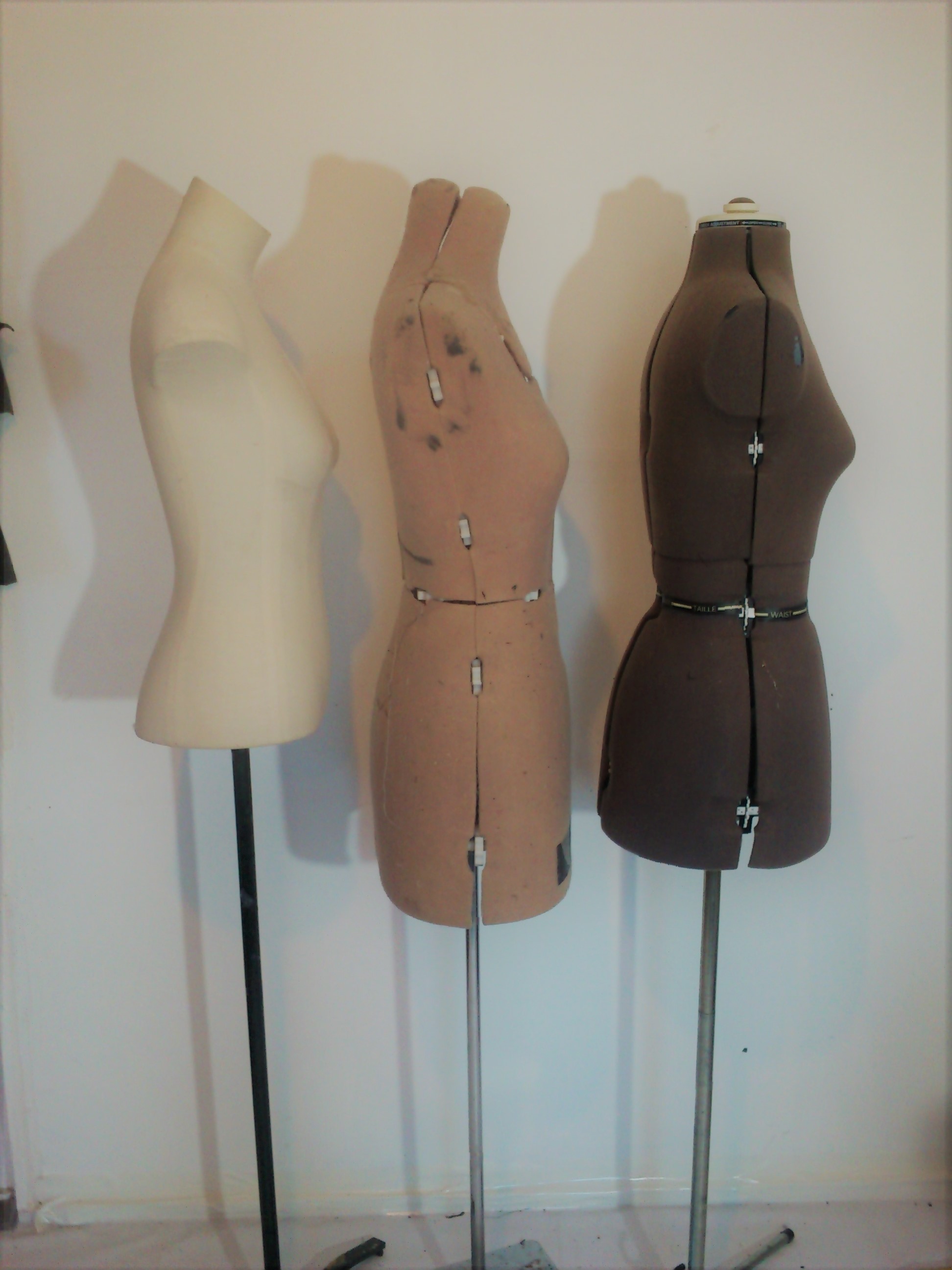


Ignoring the length differences, notice the height of the busts.
Busts:
Notice the shape and gravity defyingness. Also, the direction and placement.
When placing a dart under the bust or a seam over the bust and down to the waist there is a division of the front of the body. If I were to make the same garment for each, they would have to be adjusted for each form as generally the distance between bust points over sizes scales, the shape of the sides, and how they curve around the ribs changes.
I look at a garment on the stand and think it looks lovely, then I put it on and it is not flattering, to me I’m very circular in cross section so darts/seams don’t sit like on oval forms. So I test on all three forms for fit and balance. Nothing wrong in fit, nothing wrong in the shapes of us, just that they are different.
Hips:
The dark brown form has very round hips in cross section. They are set to the same size as the others but because the fullness is almost perfect even garments will hang very differently, and vice versa.
The bust points are also different and requires a bit of math to work out how to set the dials to bring them together/further apart- also the torsos are in four parts, there is not a lot of transformation possible!
The hips also slope slowly or curve out abruptly.
I am a mix of these three. I wind up using the dark brown form for upper hip and armscye fittings.
Backs and shoulders:
The forms also show very different stances! And when a pattern is made to fit, it will sit differently on me if I don’t match the stance.
The peachy-tan form has a ballet back! The back of the pelvis is turned under for a turn out.
The calico form has a slight sway back.
The dark brown form is bent forward slightly at the shoulders.
I haven’t called them flaws, because I stand like all three depending on circumstance. But it means I do have to really check what era is best matched 🙂
They also really are distinctive modern historic fashion stances. The dark brown in particular has a 1950s and 60s shape. The peachy-tan one looks very 1980s (the shoulders are not large but from handling this form it is easy to add shoulder padding, in fact easier than any other.) The calico form is much more modern. Built in shoulders mean no room for extra padding and an expectation of a muscular upper back.
Padding:
I use the calico form for nearly everything else as I am able to pad her to a victorian shape. I add extra hip and bust padding, which is squishy, so I can see the effect of pinching fabric in at the waist and how to taper darts or use an S shape in my dart to create an exaggerated bust.
So I use padding not only to match my shape but to match the shape I want. In the case of Mina.. that has been seriously challenging! As I am circular in cross section I cann’t squish underbust at all. So it always looks bigger in proportion. I have to wear extra.. enhancements to balance that, and even more to get that magnificent sweep of the bodice that made me fall in love with the gown.
I do generally add padding anyway.
There is so much more, obviously, there are shelves of books on the subject. Photos, diagrams, text.. anything you could want. But sometimes it takes seeing something unfamiliar to make that connection.
So that’s why I keep sharing my experiences. As both someone who has had to tackle fit for my own body and to make them both work for historical styles.
Being able to talk about the forms and their shapes